Studio Notes: Hand Lens or Macro Photo? Two Ways to See the Very Small
Question
Which simple approach helps me notice more, learn faster, and keep useful records when I study small things in the yard: a 10x hand lens or macro photography with my phone? I spent several afternoons testing both on the same subjects and wrote these studio notes to compare process, results, and practical choices.
Process
Setup A — Hand Lens (10x)
What I used: a 10x glass hand lens, a small notebook, a clip-on LED for cloudy days, and a lightweight bag. How I worked: I approached slowly, stabilized my elbow on a knee or a log, and held the lens close to my eye while bringing the subject into focus. I made quick annotated sketches and short notes about color, texture, and movement.
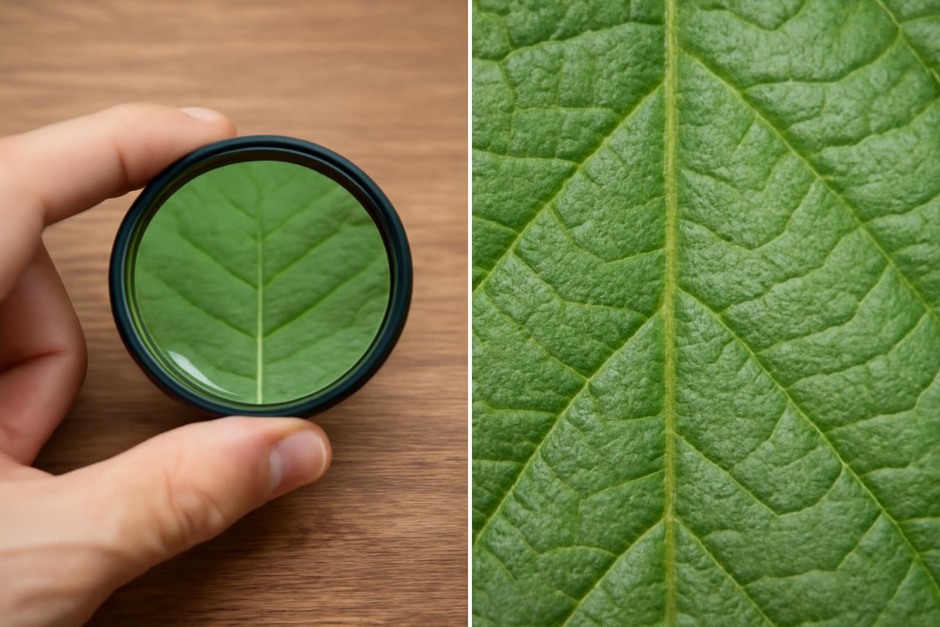
Typical subjects: moss cushions, lichen patches, insect wing venation, trichomes on leaves, soil crumbs. Where it shines: revealing three-dimensional texture and subtle color shifts; encouraging close, steady observation for minutes at a time.
Setup B — Macro Photography (Phone + Clip Lens)
What I used: my phone, a clip-on macro lens (10–15x equivalent), the phone’s camera app, and a small tripod for delicate subjects. How I worked: I framed the subject, adjusted exposure and focus manually when needed, shot several frames at different angles, and saved images to a date-stamped folder. I added brief captions in the photo notes app.
Typical subjects: insect eyes and patterns, fine hairs, spores on fungi, the underside of leaves. Where it shines: capturing repeatable, sharable images and revealing surface detail at scales that are hard to hold steady with the eye alone.
Review — What Each Method Gave Me
- Speed of use: The hand lens wins for immediacy. It requires no powering up or fiddling; you can be observing in seconds. Phone macro needs setup, and focus can be finicky on the move.
- Quality of detail: Macro photos can record ultra-fine detail and small color contrasts that escaped the eye through a lens. However, a hand lens often shows better depth perception and shading, which helps understand form.
- Engagement and learning: Using a hand lens slows me down and forces me to notice relationships — how a lichen sits on a rock, the way an insect tucks its legs. Macro photography tends to be more about capturing a moment; it can encourage movement toward documentation rather than prolonged looking.
- Record keeping: Photographs are searchable, timestamped, and easy to share or revisit. Sketches and notes taken with a hand lens are more interpretive but often contain observations I wouldn’t have thought to photograph, like slight smells, temperature, or behavior.
- Practical limits: In low light or windy conditions, a hand lens lets you get closer and stabilize with your body. Macro photography benefits from controlled lighting and a tripod; otherwise images can be soft or overexposed.
Guidance — How to Choose (or Use Both)
Here are simple decision points I used when choosing a method in the field. These reflect priorities rather than hard rules.
- If your goal is to learn by looking: Choose the hand lens. It slows observation, improves spatial awareness, and deepens memory. Use it for tracing growth patterns, comparing textures, and noticing behavior that unfolds over minutes.
- If your goal is to document and share fine detail: Choose macro photography. It’s ideal when you need reproducible images for later study, identification, or archive. Bring a small tripod and use multiple frames at different exposures.
- If conditions are difficult: Windy, low-light, or moving subjects often favor the hand lens for quick, stabilized looking. For static subjects on bright days, macro photos can capture exceptional detail.
- If you want a learning routine: Alternate. Start a session with a hand lens to slow down and make a few sketches and notes. Then photograph one or two subjects that merit repeatable records. The combination gives both mental imprint and precise images.
- If equipment or budget is a concern: A decent 10x hand lens is inexpensive, durable, and battery-free. Macro kit for a phone is relatively affordable too, but expect to practice to get sharp results.
Concluding note: both approaches are tools for attention. The hand lens trains the eye and the patience to notice; macro photography preserves the tiny worlds you find. When I pair them, observation becomes both deeper and more lasting — a small ritual that turns brief encounters into ongoing stories worth returning to.